




The software testing world sits at an inflection point. While we endlessly discuss AI, automation, and CI/CD speed, a familiar frustration still plagues the industry: The biggest persistent challenge is a fundamental misunderstanding of what testing is for, often treating it as “janitorial work” tacked onto the end of the development cycle.
Unfortunately, the tired perspective that testing is a cost center or a final gate prevents teams from achieving high velocity. The software testing trends shaping 2026 go beyond merely leveraging new tools to truly building the necessary technological scaffolding required to force an organizational mindset shift.
As quality shifts from simple QA to a world where it drives business decisions, three strategic trends will define success in the modern software delivery pipeline.
1. Agentic AI’s ascent to strategic partner
Most people think that AI in testing is simply automating the generation of Playwright or Selenium scripts. But that’s just the shallow end of the pool. The deeper change lies in AI solutions that shift the focus from manual execution to a more holistic quality strategy.
Traditional automation was about writing, executing, and maintaining scripts. Agentic AI, leveraging large language models (LLMs) and advanced machine learning, can help manage the entire regression testing process. These systems are now capable of analyzing your Git history, recent code changes, and production telemetry to determine which tests are necessary to run for a specific commit, not just running the entire suite out of habit.
After a test fails, the agent interprets logs, correlates the failure with recent changes, and identifies the specific commit or line of code that introduced the bug.
Rather than eliminating the tester’s job, this transition elevates their role. QA professionals will spend less time writing and maintaining fragile scripts and more time defining constraints, establishing guardrails, and reviewing the AI’s outputs for logic and bias. The machine takes over the mechanical work, freeing human employees to focus on the high-value problems that only intuition, ethical judgment, and business context can solve, thereby delivering real business value.
2. Shifting left and right simultaneously unifies the pipeline
For too long, teams argued over whether to shift left (testing early) or shift right (testing in production), but that false dichotomy is dissolving as a seamless, hybrid approach, built on a foundation of continuous quality observability, emerges.
Microservices and continuous delivery mean that stability is fragile. Issues emerge only under real-world, high-traffic conditions that preproduction environments cannot often replicate.
The strongest teams are now operating two simultaneous, continuous loops focused on prevention and validation:
Left loop: Focus on fast, cheap, and precise testing during development (unit tests, API contract tests, static analysis) to prevent known defects from entering the build.
Right loop: Utilize continuous monitoring, real-user data (RUM), and deliberately injecting failures to validate the system’s resilience under live stress and find unknown failures.
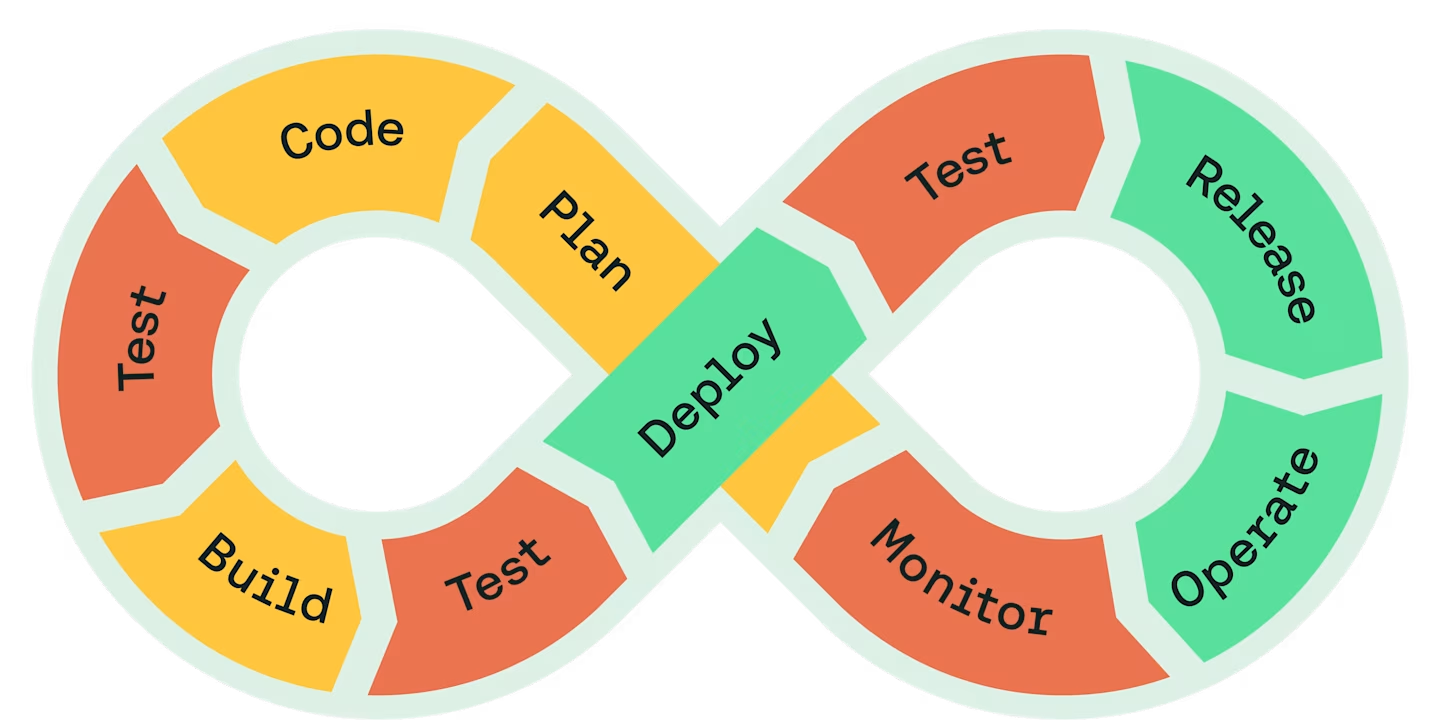
This convergence underpins intelligent DevOps since AI is only as smart as the data it can access. When code, test, and production metrics are siloed in different tools, the system as a whole cannot optimize itself.
Results from our comprehensive agentic AI survey indicate that 85% of respondents believe a hybrid approach to QA is the best way to use agentic AI, underscoring this organizational shift. By connecting preproduction failures with postproduction user behavior, the continuous feedback loop becomes a single, interconnected neural network in which testing is no longer about finding bugs but making sure your application is always available and performs as promised.
3. From cost center to revenue protector, quality’s a business metric
The most strategic trend is cultural, not technical.
A company’s QA function shouldn’t be defined by how many bugs it finds. That approach treats the QA team as a liability. Modern QA leaders should instead define quality by the revenue it protects and the velocity it enables.
Aligning quality with the C-suite’s desires is the key to unlocking resource investment. Instead of reporting “We executed 500 regression tests, and 20 failed due to UI changes,” modern software quality reports should state: “We prevented a four-hour checkout outage on our peak traffic day, securing $X in lost revenue and maintaining our target customer satisfaction rating.”
But this shift requires linking low-level test metrics (flakiness rates, execution speed) to high-level business metrics (development costs, customer retention, brand reputational damage).
According to Gartner, 81% of executives now tie software quality directly to customer satisfaction and revenue.
In 2026 and beyond, every test, every triage decision, and every deployment choice should be informed by the immediate or future impact on the customer experience and the bottom line.
Embrace continuous software quality intelligence
The future of testing is not human or machine but the strategic orchestration of both.
We must move past the idea that new tools like Playwright or AI are a magic fix for poor processes. They are powerful accelerators that demand a mature, strategic foundation.
If your team is still bottlenecked by fragile automation or late-cycle testing, the solution is not more execution but more intelligence. The convergence of agentic AI, unified observability, and a focus on business metrics will redefine the quality engineer as a vital partner in your business’s success.
It’s time to move beyond pass/fail results and harness the power of software quality intelligence.
Ready to transform your software testing and QA function into a continuous value driver? Dive deeper into the process changes that unlock velocity and strategic value: Check out The Continuous Quality Operating Model for Software Testing.

Stop letting QA be the bottleneck on AI-speed development.
Stop letting QA be the bottleneck on AI-speed development.


.png)

.png)